
Behavioral health practices
Your therapists are burned out and your waitlist keeps growing
Behavioral health practices face a math problem: demand for services is rising, clinicians are maxed out, and the admin work between sessions keeps piling up. AI can take on the operational load so your clinicians can focus on the people in front of them.
The problem
Where behavioral health practices lose time and capacity
52% of therapists experienced burnout in the past year
A SimplePractice survey found that more than half of therapists reported burnout in the last 12 months, with 29% saying they are currently burned out. Administrative burden was cited by 55% of respondents as a top contributor, ahead of compassion fatigue at 54%.
No-show rates in behavioral health run 20% to 40%
Research published in Psychiatric Services found that behavioral health settings consistently report no-show rates far above general medicine. One multi-site study of 67 treatment organizations recorded a mean initial no-show rate of 37%. For a practice billing $150 per session, even a 25% no-show rate across four clinicians erases more than $200,000 a year.
56% of psychologists have no openings for new patients
An APA survey found that over half of psychologists had no availability for new patients. Among those maintaining waitlists, average wait times ran three months or longer, and nearly 40% said their waitlist had grown in the past year. Patients who wait too long often disengage before treatment starts.
Therapists using AI for admin save an average of 13 hours per week
A November 2024 SimplePractice survey of clinicians found that those using AI tools for documentation, scheduling, and communication saved 13 hours per week on average. Yet only 50% of clinicians have adopted these tools, meaning half the field is still spending that time on paperwork instead of patients.
Where AI helps
Practical AI applications for the problems above
Cut no-shows with reminders built for recurring sessions
Behavioral health appointments are recurring by nature, which makes no-show patterns predictable. AI scheduling tools learn each patient's attendance history and send reminders timed to their response patterns. When a cancellation opens a recurring slot, the system contacts waitlisted patients automatically. Practices using these tools have cut no-show rates by more than half.
Automate intake and screening workflows
AI intake systems send new patients digital forms before their first session, collect responses, flag incomplete submissions, and pre-populate your EHR. Standardized screening instruments like the PHQ-9 or GAD-7 can be administered and scored automatically at set intervals, giving clinicians structured data without adding manual steps.
Reclaim documentation time with AI-assisted notes
AI note-taking tools generate structured session notes from audio or clinician input, formatted to your practice's documentation standards. Clinicians review and approve rather than write from scratch. The 13 hours per week that early adopters are recovering translates directly into additional session capacity or reduced after-hours work.
Keep patients engaged between sessions
AI-powered communication tools send appointment confirmations, session preparation prompts, and between-session check-ins on a schedule you define. Automated outreach keeps patients connected to their treatment plan without requiring staff to manage each message manually.
Move your waitlist faster with intelligent scheduling
AI scheduling tools match waitlisted patients to open slots based on provider availability, session type, and patient preferences. When a recurring appointment cancels, the system fills it from the waitlist before your front desk picks up the phone. That turns dead time into billable sessions.
Track outcomes without adding paperwork
AI dashboards aggregate screening scores, session frequency, and treatment milestones into a single view. Clinicians can see patient progress over time without manually pulling reports. Practice owners get a clear picture of clinical throughput and treatment effectiveness across their team.
Why LightSource
We understand how behavioral health practices operate
LightSource Advisors knows that behavioral health runs on recurring relationships, sensitive communication, and a careful balance between clinical care and business operations. We are vendor-neutral, so we recommend tools that fit the way your clinicians actually work, not what pays us a referral fee. Every recommendation respects the therapeutic relationship and the privacy standards your patients expect.
How it works
Three steps from assessment to results
Step 1
Assess
We audit your scheduling, intake, documentation, and patient communication workflows to identify where AI removes administrative burden without disrupting the clinical relationship.
Step 2
Plan
You receive a prioritized roadmap with specific tools, expected time savings, and an implementation timeline built around your caseload and team size.
Step 3
Build and stay
We implement alongside your team, train your clinicians and staff, and remain engaged until the tools are producing the outcomes we projected.
Ready to act
Find out where AI fits in your practice
The AI Readiness Assessment gives you a scored roadmap of your highest-impact opportunities. No pitch, no pressure. Just a clear picture of what is worth doing first.
Start a conversationSources
- SimplePractice. "Therapists Are Burning Out — Here's Why." 2024. Cites 52% of therapists experiencing burnout in the past 12 months, with 55% naming administrative burden as a top contributor. simplepractice.com
- Psychiatric Services (American Psychiatric Association). "Elimination of Behavioral Health Wait Times: Impact on 'Avoidable' Medical Visits, Productivity, and Revenues." 2024. Reports mean initial no-show rate of 37% across 67 behavioral health treatment organizations. psychiatryonline.org
- NPR / American Psychological Association. "Survey: Psychologists keep long waitlists as they struggle to meet demand." December 6, 2023. Cites 56% of psychologists with no openings and average wait times of three months or longer. npr.org
- SimplePractice. "How Therapists Use AI and ChatGPT to Tackle Admin Work." November 2024 survey. Cites 50% of clinicians using AI for daily administrative tasks and average time savings of 13 hours per week among adopters. simplepractice.com
- HRSA Bureau of Health Workforce. "State of the Behavioral Health Workforce, 2025." U.S. Department of Health and Human Services. Documents ongoing behavioral health workforce shortages and burnout trends. hrsa.gov
Statistics cited from original sources. Dates reflect the most recent available data at time of publication.
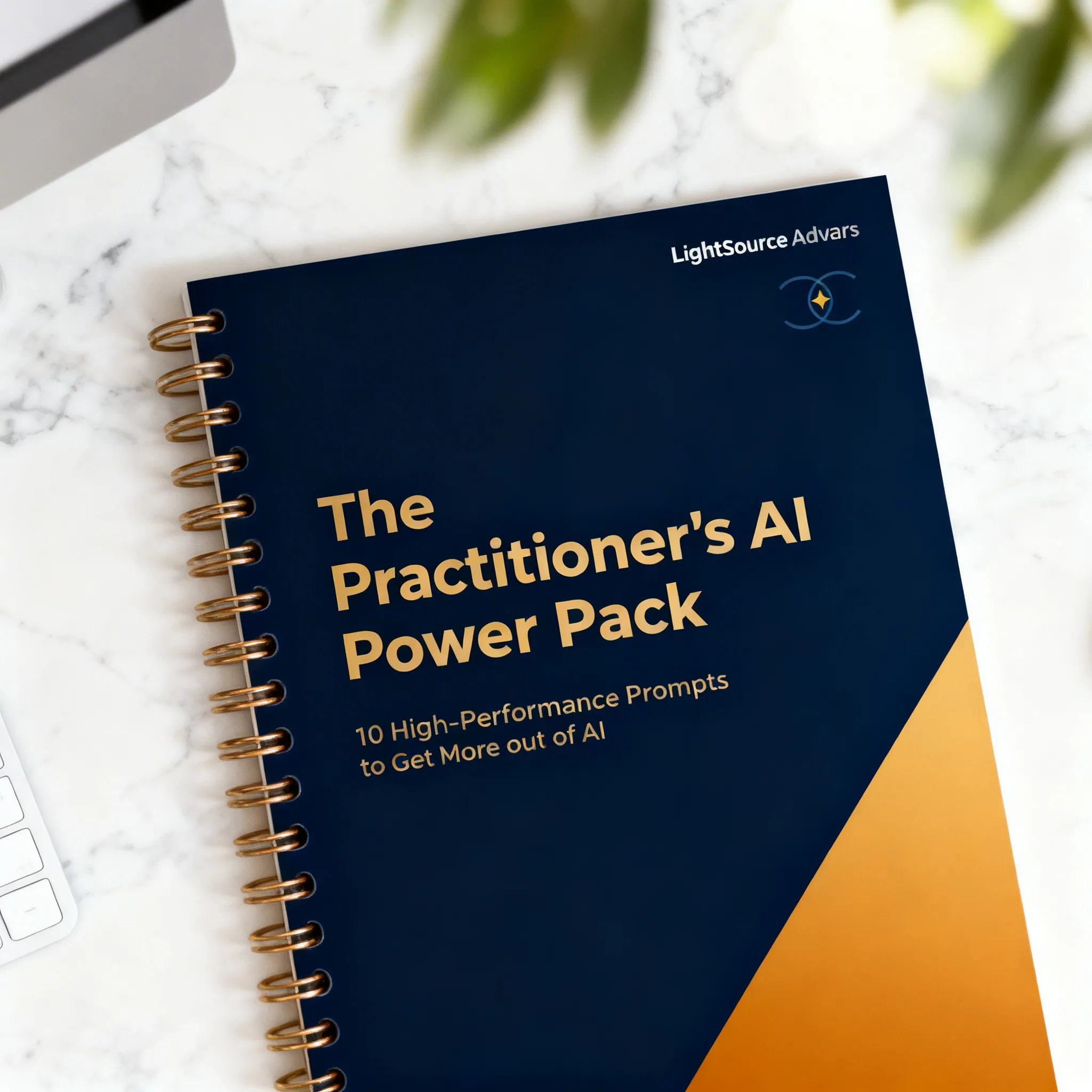
Download the Practitioner's AI Power Pack
9 hours of Google's prompt engineering course, distilled into 10 templates built for healthcare and wellness. Revenue Protection, Marketing and Growth, Operational Efficiency, Strategy and Training.