Myth-busting
Steve Jobs said you could poke life. Here's your stick.
By Nirav Desai · Mar 31, 2026

In a 1994 interview, a young Steve Jobs explained something most people spend their whole lives missing.
"Everything around you that you call life was made up by people no smarter than you," he said. "You can change it, you can influence it, you can build your own things that other people can use." Then he went further: once you realize you can poke life and something will pop out the other side, you'll never see the world the same way.
He was talking about creative audacity — the willingness to try. Most people don't. Not because they lack imagination, but because the distance between idea and execution has always been expensive, slow, and punishing of mistakes.
AI is closing that distance. Faster than most people realize, and in ways that matter directly to how you run a practice.
The myth worth dropping
The prevailing assumption in healthcare and wellness is that AI belongs to enterprise IT departments and well-capitalized tech companies. That it requires specialized staff, long implementation timelines, and budgets most independent practices don't have.
That assumption is about three years out of date — and the organizations still holding it are leaving real efficiency on the table.
What's actually changed
For most of modern business history, bringing a new operational idea to life meant a full sequence: budget approval, vendor selection, development, testing, rollout. The cost of trying was high enough that most ideas never got tested at all.
AI compresses that sequence. A wellness group that wanted an automated patient intake workflow a few years ago might have needed a consultant, custom development, and several months. Today, with the right tools and guidance, the same workflow can be prototyped in days and refined in weeks. The economics of iteration have changed.
Startups figured this out first. Small teams are now building, testing, and deploying things that previously required much larger organizations. A two-person founding team can move at a pace that was impossible five years ago, because AI removes the need for dedicated headcount on tasks that don't require human judgment.
Independent practices and growing wellness clinics have more in common with startups than most realize. You're running lean, wearing multiple roles, and making consequential decisions with limited time and limited staff. The same tools that help a startup punch above its weight are available to you.
What this looks like in practice
For a practice manager, the applications are rarely glamorous. They're the daily friction: scheduling gaps that cost revenue, staff time absorbed by repetitive administrative tasks, communication workflows that depend entirely on one person remembering to follow up, operational data that's been collected for years but never actually used.
None of that requires a technology overhaul. It requires identifying which problems are worth solving first, and finding tools that fit the scale you're actually operating at.
The more important point is who does that work. AI doesn't arrive and replace the coordinator who knows your patient base or the ops manager who understands why your Tuesday mornings are always underwater. It works alongside them. It takes the parts of a job that don't require human judgment and handles them — so the people who carry your institutional knowledge can use it where it counts.
That's the myth worth addressing directly: AI adoption is not a headcount reduction strategy. It's a capacity strategy. Your team doesn't become obsolete; they get better tools.
The permission Jobs was really talking about
His insight in that interview wasn't really about technology. It was about permission — the recognition that the world isn't fixed, that the people who built it weren't operating from some higher plane of intelligence, and that you're allowed to try something different.
AI doesn't eliminate the need for judgment. In healthcare and wellness, human judgment is the center of everything you do. But it does lower the cost of trying. It shortens the distance between "what if we approached this differently" and an actual answer.
You can poke life now. The question is whether you're willing to reach.
LightSource Advisors helps healthcare and wellness organizations cut through the noise and find where AI actually moves the needle. No vendor bias. No jargon. Just clear guidance on what works.
READY TO ACT
Ready to see where AI fits in your operation?
Most clients start with the AI Readiness Assessment. It takes 60–90 days, costs $15,000–$35,000, and gives you a scored roadmap you can act on immediately.
Start a conversation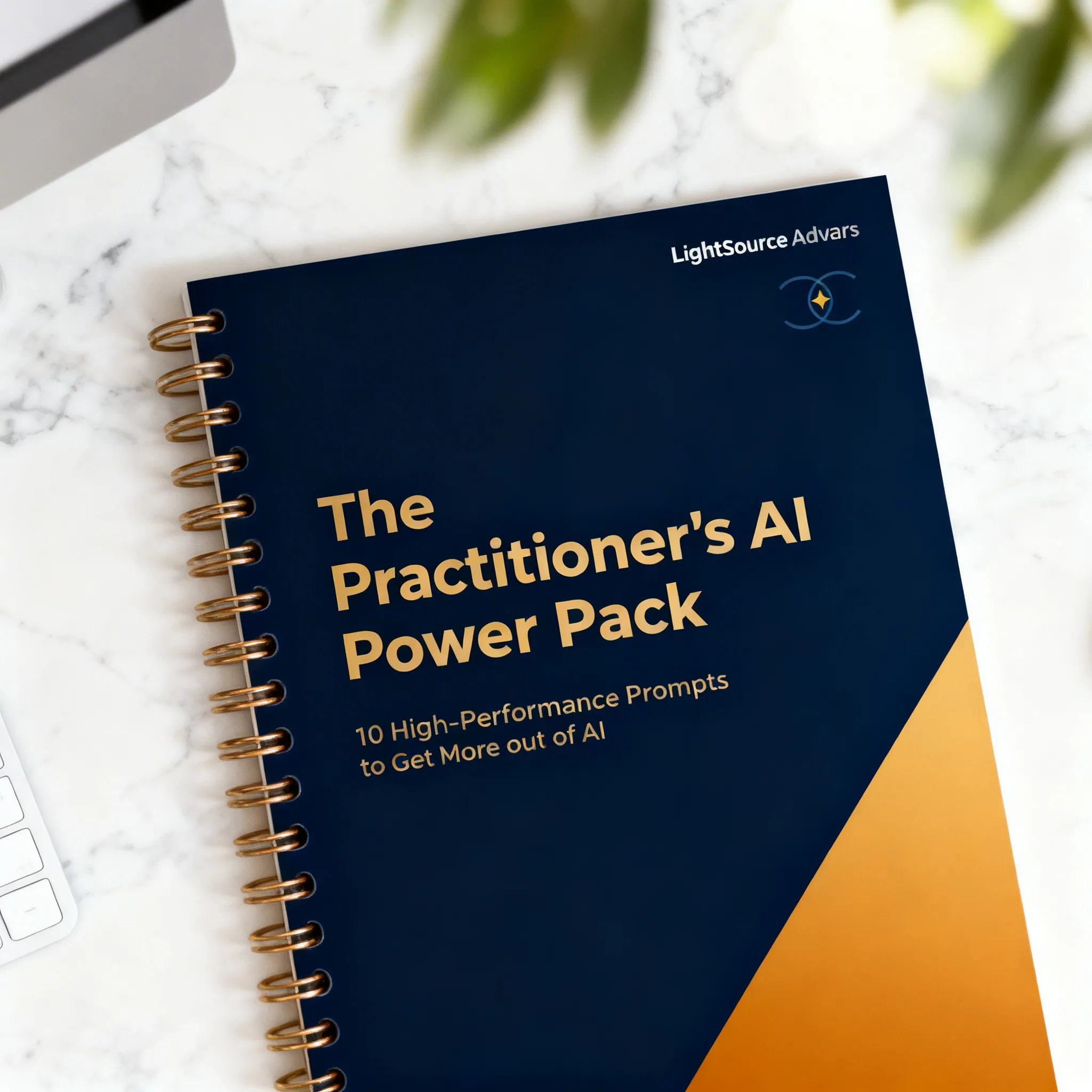
Download the Practitioner's AI Power Pack
9 hours of Google's prompt engineering course, distilled into 10 templates built for healthcare and wellness. Revenue Protection, Marketing and Growth, Operational Efficiency, Strategy and Training.